Mechanical · MP-01
Drone Launch & Landing System
A wildfire is cheapest to fight in its first minutes. This project designed the pair of electro-mechanical systems that let a large surveillance drone take off and be caught again — in terrain that offers no runway.
- Semester
- 01
- Period
- Autumn 2024
- Group
- 3.001A · 5 people
- Supervisor
- Lars R. Jensen
- Outcome
- Design & analysis
Brief
The project began from how wildfires behave and spread, and from the fact that early detection is the single largest lever on the damage they cause. A large fixed-wing drone carrying an infrared camera can patrol for ignition — but a fixed-wing aircraft needs a runway, and the terrain where it is most needed offers none.
Greece was taken as the case, with its ecosystem, topography, fire economics and working regulations framing the requirements. The task was to design a matched pair of systems: one to accelerate the drone to flying speed, and one to catch it on return.
Approach
The initiating problem was narrowed through problem analysis into a case, then a formal problem statement. Each system got its own function analysis with primary and secondary requirement specifications, and concepts were generated and filtered through a morphological analysis, a reference selection matrix, and a weighted decision matrix before a concept was committed to.
A runway was explicitly evaluated against a launch-and-catch system as alternatives, rather than assumed away — mobility of the equipment was itself one of the deciding criteria.
The systems
Launcher
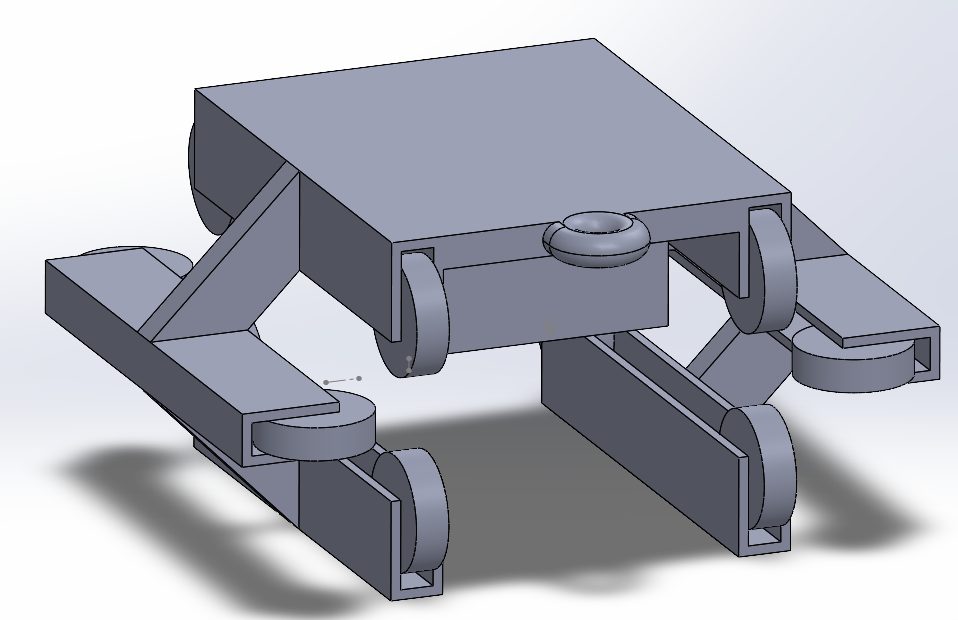
A long rail carrying the drone, with a pair of front legs for stability. An electric motor and belt pulley accelerate the drone along the rail to release speed.
Catcher
Two tall towers with a bungee cord strung between them, which the returning drone flies into and which absorbs its energy. The towers are stabilised with support cables.
Material
Both systems are built predominantly from 5083 aluminium, selected for being inexpensive, malleable and light — the last of which matters directly, because equipment that has to be moved to the fire has to be movable.
Engineering
- Force analysis of the launch system — the rail, the front legs, and the spring forces involved in acceleration.
- Force analysis of the landing system, including the bungee cord that has to decelerate the drone without damaging it.
- Motor and battery pack sizing from the required acceleration.
- Material and alloy selection against cost, weight and workability.
- Full CAD in SolidWorks, with both systems tested against known forces and analytical formulae.
What I took from it
- My first full pass through the AAU Problem Based Learning cycle — from a broad societal problem down to a specific, defensible engineering brief.
- Using selection matrices to justify a concept to someone else, rather than defending a preference after the fact.
- Designing two systems that have to agree with each other about the same drone.