Mechanical · MP-02
Residential Trash Compactor
Packaging is most of what fills a household bin, and almost all of it is air. TRAS compresses plastic waste to a third of its volume — designed against a hard price ceiling, because a product nobody can afford does not reduce anyone's waste.
- Semester
- 02
- Period
- Feb–May 2025
- Group
- 3.025C · 6 people
- Supervisor
- Benny Endelt
- Outcome
- Design & costing
Brief
Household packaging waste takes up far more volume than its mass warrants. With limited storage space in a kitchen, that volume is what forces people to take the bin out — frequently, and long before the bin is actually full of anything.
The project set out to develop a bin capable of compressing plastic waste at a ratio of 3:1. Requirements were gathered and weighted, and the one that came out on top was price — the target was a product that could retail under 4,500 DKK. Every subsequent decision was made against that constraint.
The work ran under Aalborg University's Problem Based Learning model, with input from students and from Nordværk, the regional waste management company, to frame the problem against how waste is actually handled.
Approach
Establishing the load
Rather than assume a compaction force, the group ran an experiment to determine the pressure actually required to compress household plastic waste to the target ratio. That measurement — not a guess — became the input that sized the motors, the gearing and the structure.
Concept selection
Existing products on the market were surveyed, the complications of compressing mixed waste were analysed, and concepts were generated through function/means trees and a morphological chart before a design was chosen against the weighted requirements.
Designing for a price
Hitting the price target meant treating manufacturing as part of the design. The group contacted manufacturers for quotes on the specially designed parts and on casting moulds for in-house production of sub-components, built a bill of materials for the standard parts, and calculated production time and cost for the finished product.
Engineering
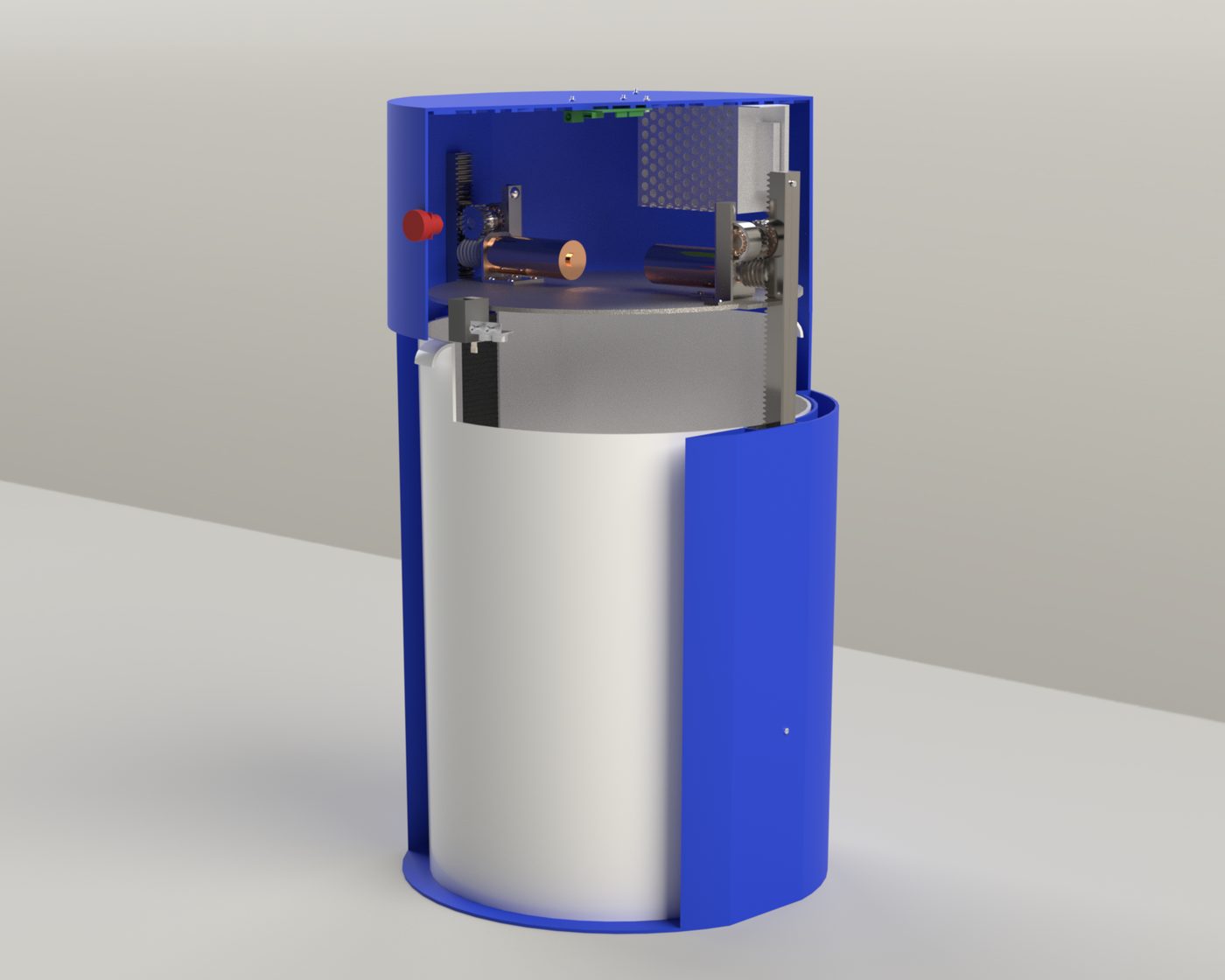
- Mechanism. A press plate driven by electric motors through a gear train, compressing waste inside a purpose-designed container.
- Drive calculations. Motors and gears were checked against the measured requirement to confirm they could actually deliver the necessary force.
- Gear tooth strength verified by separate control calculation.
- 3D models in SolidWorks, with technical drawings produced from them.
- Finite element analysis of the loads the compactor sees in use, plus explicit analysis of critical scenarios — what happens when it is loaded in the worst way a user might load it.
- Convergence analyses to confirm the FEA models had settled and their results could actually be relied on.
- Material and process selection, including injection moulding for the produced components.
Results
3:1
Compression ratio10 kPa
Delivered pressure822 DKK
Production cost4,500 DKK
Retail target — beatenThe calculations show the compactor delivers the 10 kPa required to compress waste at 3:1, and the finite element analyses — validated by convergence studies — show it does so without critical failure.
The final production cost came out at 822.11 DKK, comfortably inside the 4,500 DKK retail target that had been the highest-weighted requirement in the specification.
What I took from it
- Measuring the load instead of assuming it, then sizing the whole drivetrain from that measurement.
- Treating cost as an engineering requirement with the same standing as strength — and designing the manufacturing route, not just the part.
- Running FEA responsibly: a convergence analysis is what separates a result from a colourful picture.