Mechanical · MP-03
Towpreg Machine for Small-Scale Production
A real client with a real problem: FiberJoints could not buy the material they needed, because every supplier's minimum order dwarfed their annual use. So we designed them a machine to make it themselves — at roughly half the price per metre.
- Semester
- 03
- Period
- Sep–Dec 2025
- Client
- FiberJoints
- Group
- 3.220 · 5 people
- Report
- 136 pages
Brief
Towpreg is carbon fibre tow pre-impregnated with resin before layup. It is normally made on capital-heavy industrial lines, which sets a minimum order quantity — and that quantity is a wall for anyone who needs a small amount.
FiberJoints, a small Danish company producing carbon fibre patches for composite applications, sat squarely behind that wall: they could not source towpreg because every supplier's minimum order far exceeded what they use. The project, run in direct collaboration with the company, was to design a compact, low-capital machine that lets them impregnate their own.
Problem statement
How can a towpreg machine be designed that saturates carbon fibre with epoxy to FiberJoints' requirements — at low startup cost, with minimal labour time, and producing at least 2,500 m of towpreg per 8-hour shift?
Process
Requirements and wishes were established in dialogue with FiberJoints, then taken through a structured concept development sequence rather than jumping to a favourite idea.
- Function tree. Every element a working towpreg machine needs was mapped and its requirements analysed.
- Morphological chart. Each sub-function was brainstormed separately, then recombined across the chart into candidate concepts.
- Pugh matrix, weighted from a House of Quality, to select between them on the criteria the client actually cared about.
- Three design iterations, each driven by the calculations rather than by taste — bearings added, profiles changed, parts redesigned for manufacturability.
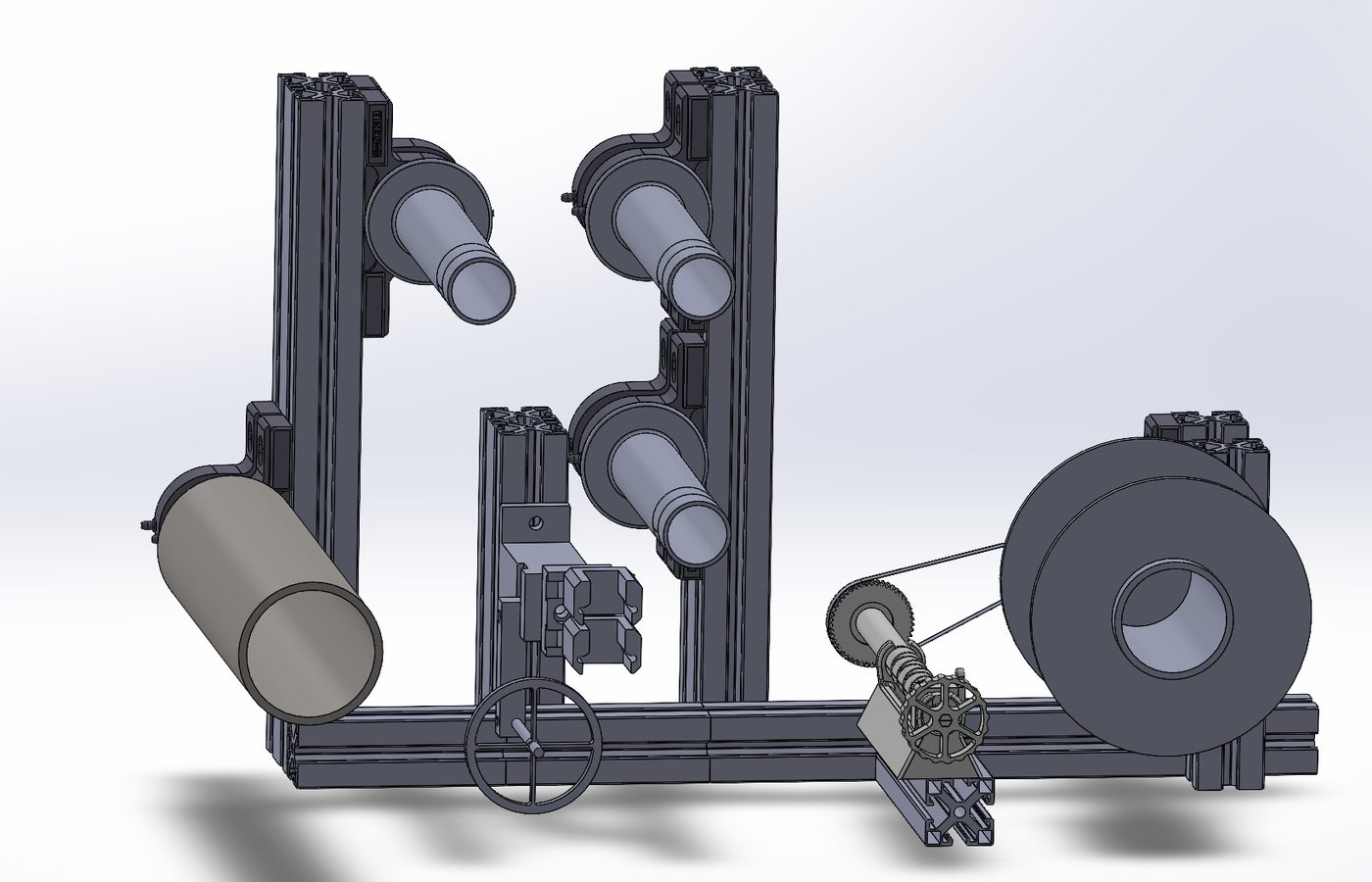
The machine had to hold a dry carbon fibre spool, keep the fibre under constant tension, saturate it with epoxy, remove the excess, allow the epoxy to be heated, wind the impregnated tow back up, and keep the saturated strands from touching each other.
The machine
Impregnation and scraping
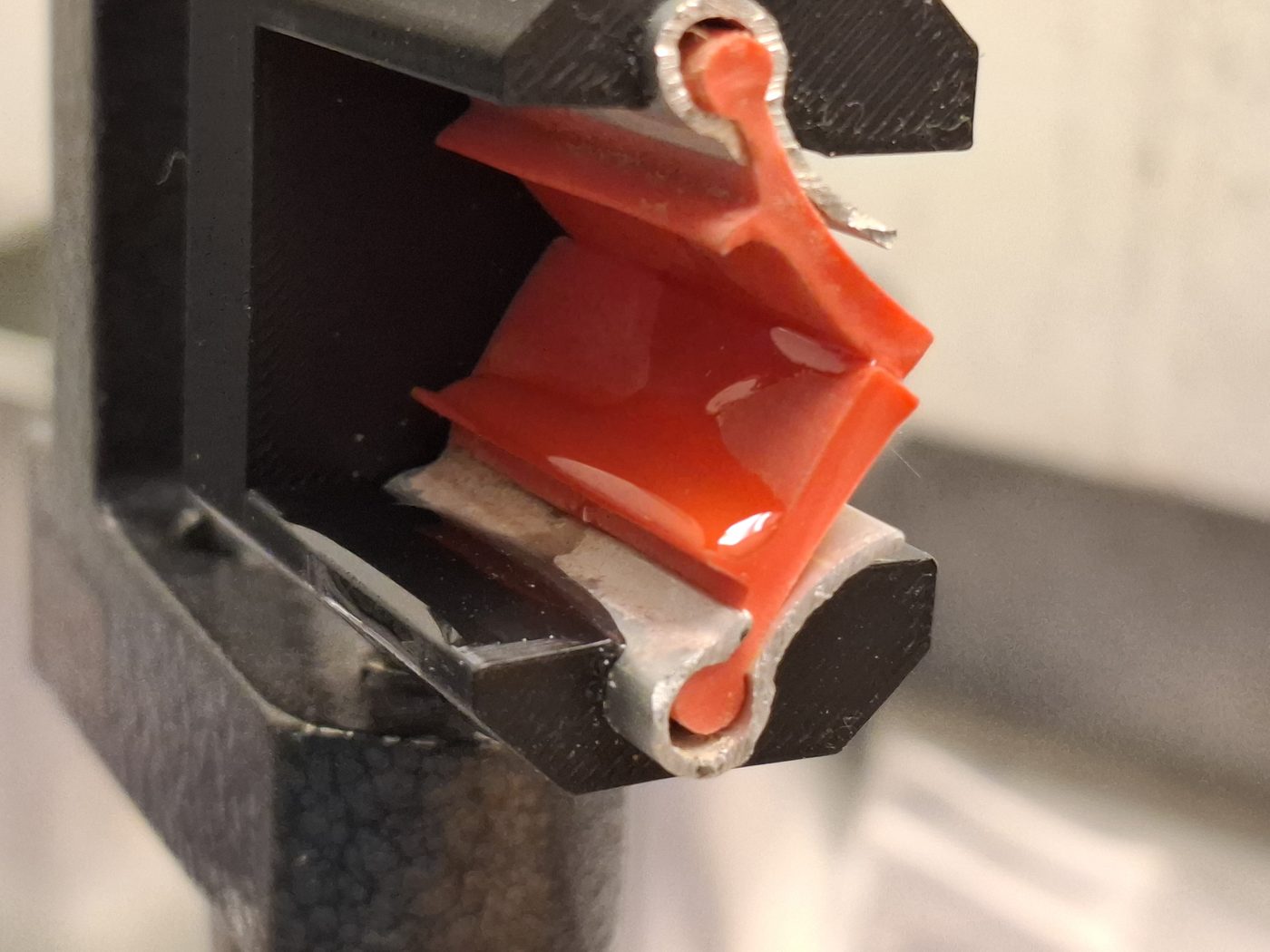
Tow passes over a dip wheel through the epoxy bath, then through a scraper that strips the excess. Getting that scraper right was the core of the design: the resin-to-fibre ratio is set by how much epoxy the scraper leaves behind, so it determines whether the output meets the quality specification at all.
The final design pulls the fibre through the centre of the scraper, with the holder lockable at a chosen angle and room for two rubber scrapers — so scraping force can be increased if needed and worn scrapers swapped out easily. The dip wheel was redesigned for simpler manufacture in either PETG or steel: PETG parts submerged in epoxy are cheap to replace, steel ones can be cleaned.
Tensioning and winding
Every rotating component ended up on two UCP205 flange bearings rather than one — the calculations showed a single bearing would exceed its fatigue strength over the machine's intended life. The frame's vertical aluminium profiles were changed to double-slot to make room for the second bearing and larger angle brackets.
The take-up spool housing was sized to 170 mm against a calculated final spool diameter of about 161 mm, leaving roughly one and a half extra layers of margin for the uncertainty in how many turns each layer really contains.
Engineering
- Lab trials. The impregnation process was tested in a laboratory to find the right saturation and the correct weight distribution between fibre and resin, with epoxy casting, grinding and microscopy of the test pieces.
- Tension testing. A separate experiment characterised the tension behaviour of the tow through the machine.
- Motor dimensioning against the dynamic loads of a continuously moving line.
- Strength calculations, finite element analysis and material fatigue across the structure.
- Full manufacturing package — working drawings, assembly drawings, bill of materials and assembly instructions.
- Life cycle cost analysis covering capital, operating and maintenance costs.
- Risk assessment, safety and legislation, including the Danish working environment rules for handling epoxy and isocyanate products.
Results
0.74 kr/m
Produced cost per metre1.30 kr/m
Market purchase price~43%
Cost reduction2,500 m
Target output per 8 hThe impregnation trials showed the machine's method of removing excess epoxy is sufficient to produce towpreg that meets the quality requirement, and the dimensioning and strength calculations put every selected component inside acceptable load levels for FiberJoints' use.
The cost analysis found the machine could produce towpreg at roughly 0.74 kr per metre against a purchase price of about 1.30 kr per metre — and that capital cost has relatively limited influence on the per-metre figure once spread across the machine's lifetime and output.
Honest limitations
The trials used a limited number of samples, and no mechanical or material testing was performed on the finished towpreg. Those tests would be needed to document material quality properly, and longer-run operation would be needed before the operating and maintenance costs are more than a qualified estimate. The cost figures should be read as estimates, not measurements.
What I took from it
- Designing to a external client's constraints — cost, labour time and throughput — rather than to an academic brief.
- Letting a structured selection process pick the concept, then letting the calculations drive each iteration.
- Costing a machine over its life cycle, and being able to state the number that actually decides whether it gets built.