Mechanical · MP-04
Plastic Sorting Machine using Hyperspectral Imaging
A working prototype that identifies plastics by their spectral signature and sorts them with delta robots — including the black plastics that conventional near-infrared sorting cannot see. Built by a six-person group as the 4th semester project.
- Semester
- 04
- Period
- Feb–May 2026
- Group
- 4.012A · 6 people
- Supervisor
- Mogens Hinge
- Outcome
- Working prototype
Brief
Most recycling facilities separate plastics by flotation — floating buoyant polymers in water and skimming them off — usually combined with near-infrared and visible-light cameras. That combination cannot distinguish plastics that share a density, cannot separate polymers carrying different additives, and is effectively blind to black plastics, which absorb the near-infrared light the sensors depend on.
The project set out to prove that hyperspectral imaging paired with robotics is a viable sorting technology, by building a prototype that identifies and separates polymer types with high specificity — and to use that prototype as a test rig for finding the practical problems the approach runs into.
How it works
A standard camera samples three colour channels. A hyperspectral camera samples a continuous spectrum from roughly 380 nm to 1740 nm, producing an image for every measured wavelength. Stacked together these form a hypercube: two spatial axes, and a third spectral axis.
Because every material absorbs light in a characteristic pattern, the spectrum at each pixel identifies what that pixel is made of. Spanning both the visible and the near-infrared range means the system reads colour and material — so black plastics are identifiable, and additives and impurities show up as discrepancies against the pure-material spectrum.
The camera
The Qtechnology QT-5022 builds its data cube by push-broom scanning: it captures one spatial line at a time with the full spectrum for that line, then assembles successive lines into a complete image as the conveyor moves the material past. Light passes through a slit, is collimated, is split by a dispersive element, and lands on a 2D detector where one axis is position along the slit and the other is wavelength.
The build
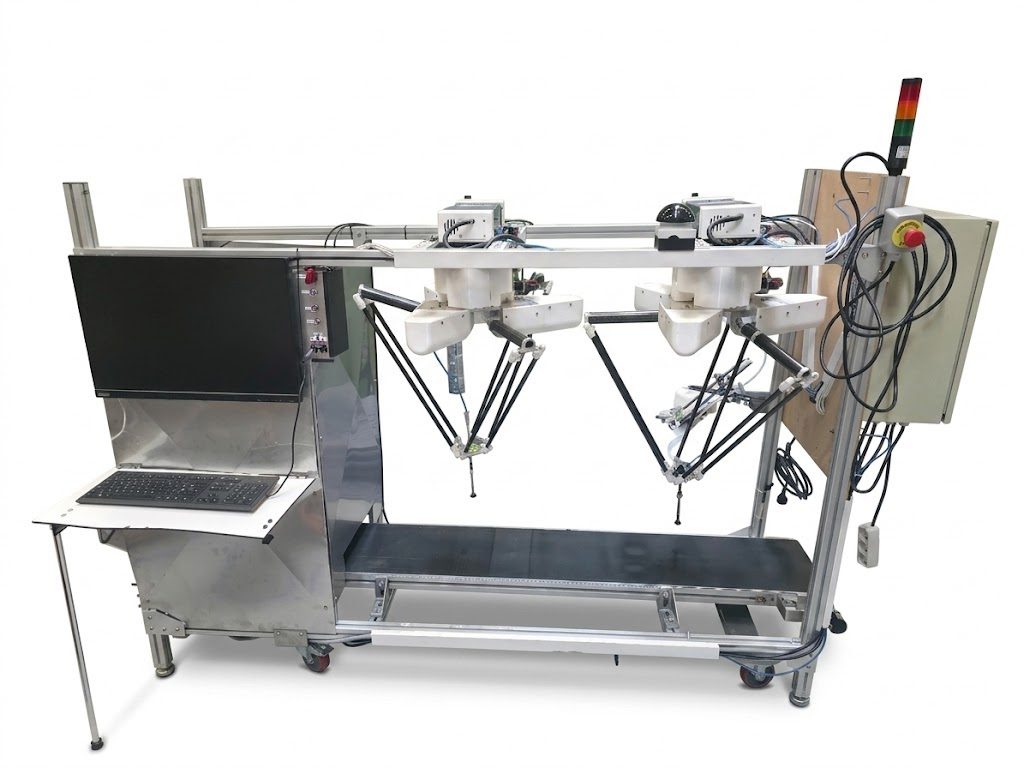
The machine is built on an extruded aluminium profile frame, chosen so dimensions could keep changing as the build progressed. A hard constraint of 900 mm maximum width was enforced throughout so the finished machine would fit through a standard doorway.
- Conveyor driven by a 0.18 kW geared motor through a 30:1 worm gear, with an Omron incremental rotary encoder tracking belt position so the vision system knows where each piece has travelled to.
- Two delta robots performing the physical pick-and-place into the correct container.
- Two halogen lamps providing the broad, continuous illumination spectrum hyperspectral imaging requires — LEDs have too spiky an emission spectrum for the job.
- A cast camera mount, verified by finite element analysis against strength data from a tensile test.
- A quick mount / dismount system, designed and tested so the rig can be reconfigured between experiments.
My contribution spanned the mechanical construction and the FEA verification.
Vision & software
A hypercube is far too much data to classify raw, so the pipeline reduces it before deciding. Principal component analysis compresses the spectral axis down to the components that actually carry discriminating information, and a support vector machine classifies each pixel from those components into a polymer type.
The camera was calibrated, the sorting algorithm was trained and calibrated against known samples, and classification results are passed as G-code move commands to the delta robots — which is where the machine's name comes from: the G-code Operated Omnidirectional Non-recyclables Extraction Robot.
Code
The control software is split by concern rather than kept in one script:
separate Camera, Encoder and robot
modules, a RobotGUI for operating the machine, a
data_anal module for the spectral analysis, and a test file.
It is public in the
MP4Projekt repository.
Results
The prototype sorted plastics correctly by type — PET, PLA and PE among them. Material is fed onto the conveyor, scanned by the hyperspectral camera, classified, and picked into the correct container by a robot arm. Absorption lines identified in the captured spectra confirmed the camera can detect the additives present in a plastic as well as the polymer itself.
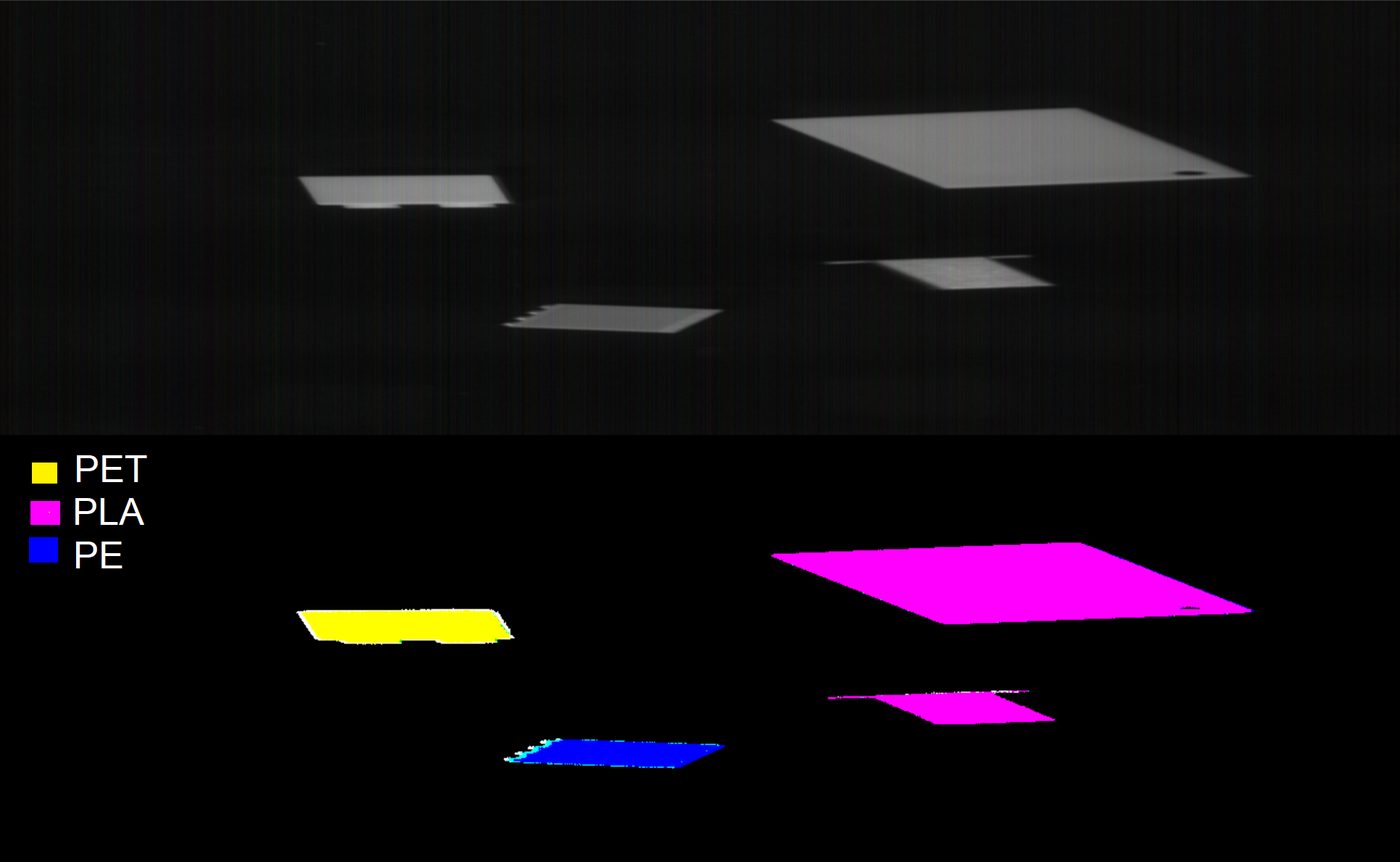
The comparison is the whole argument for the approach: in the raw scan the four samples are near-identical greys that no colour camera could separate. In the classified output each one is resolved to a specific polymer.
380–1740 nm
Spectral range4.0
Camera mount safety factor2
Delta robots900 mm
Max width — fits a doorwayVerification
The camera mount was simulated by finite element analysis using strength data measured in a tensile test. A convergence analysis across mesh sizes returned a constant 10.44 MPa, confirming the result was a property of the part rather than of the mesh. The mount carries the camera with a safety factor of 4 — and that figure was calculated using a camera mass higher than the real one.
What I took from it
- Building a machine where the mechanical design, the electrical system and the classifier all have to agree on timing — a belt encoder is what makes the vision result land on the right object.
- Verifying a load-bearing part properly: tensile test for real material data, FEA, then a convergence analysis rather than trusting the first mesh.
- Working in a six-person group against a fixed semester deadline on a prototype with no guarantee it would work.